


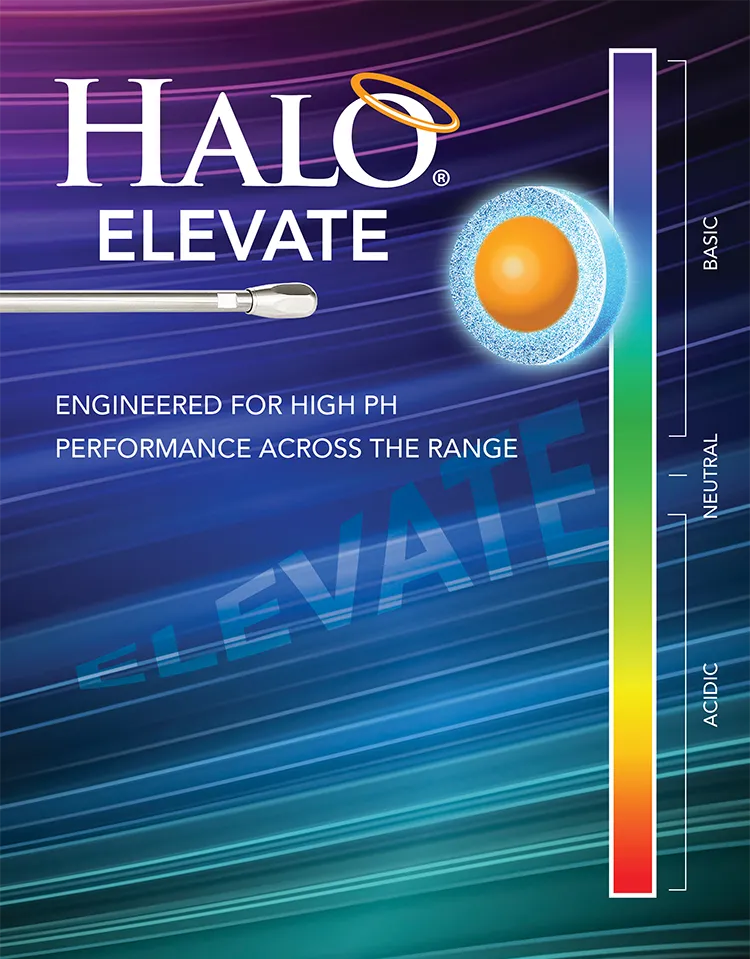
HALO® ELEVATE – Engineered for High pH Performance Across the Range
Built upon proven Fused-Core® particle technology for speed and efficiency, the HALO® ELEVATE product family incorporates surface modified organo-silane technology for alkaline resistance resulting in excellent stability in high pH environments.
With a wide operational use range of pH 2-12, HALO® Elevate allows for robust method development and improved separations for basic compounds that may present problems such as poor peak shapes, inadequate retention or limited load tolerance at low pH. Ideal for use with high pH mobile phases.
FEATURES OF HALO® ELEVATE

Three Phase Offerings: C18, C8 and PHENYL-HEXYL
Excellent stability for high pH, high temperature environments
Three Particle Sizes: 2, 2.7 and 5 µm
Robust Column Option to work the full range of operating conditions for separation selectivity of acids, bases, neutrals and zwitterions
Proven HALO® Fused-Core® technology for uniform column loading, quality separations, speed and ruggedness
PRODUCT CHARACTERISTICS
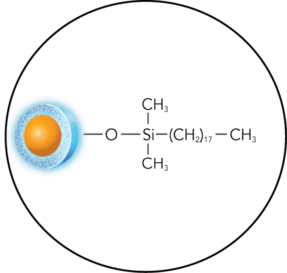
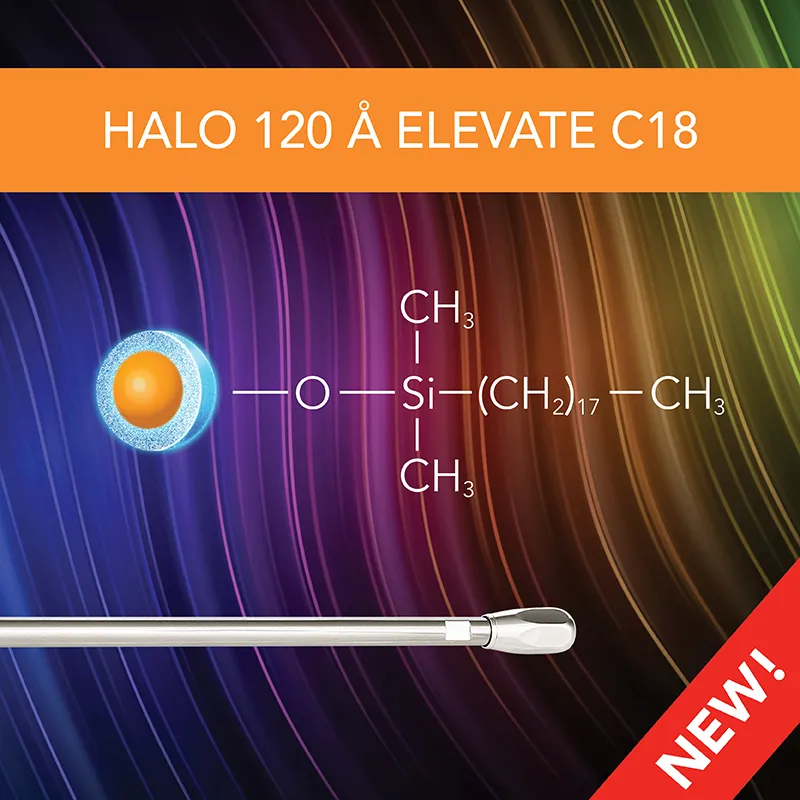
C18
Ligand: dimethyloctadecyl
Particle Size: 2, 2.7 and 5µm
Pore Size: 120 Å
USP Designation: L1
*Reported: 2, 2.7, 5µm respectively
Carbon Load*: 5.2%, 5.6%, 4.5%
Surface Area*: 70, 75, 60 m2/g
Endcapped: YES
pH Operating Range: 2-12
Temp Limit: 60 °C
Pressure Stability*: 1000, 600, 600
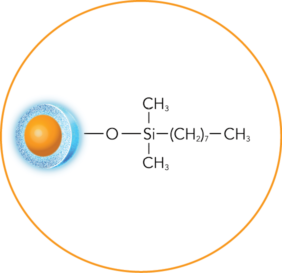
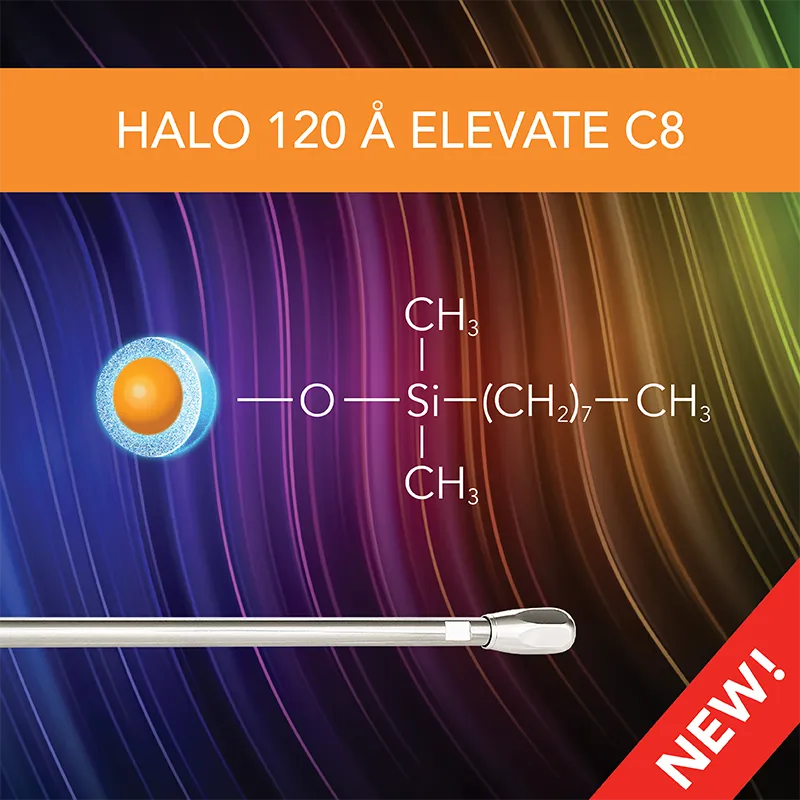
C8
Ligand: dimethyloctyl
Particle Size: 2, 2.7 and 5µm
Pore Size: 120 Å
USP Designation: L7
*Reported: 2, 2.7, 5µm respectively
Carbon Load*: 3.8%, 4.2%, 3.2%
Surface Area*: 70, 75, 60 m2/g
Endcapped: YES
pH Operating Range: 2-12
Temp Limit: 60 °C
Pressure Stability*: 1000, 600, 600
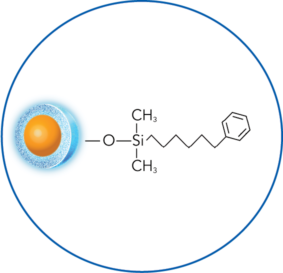
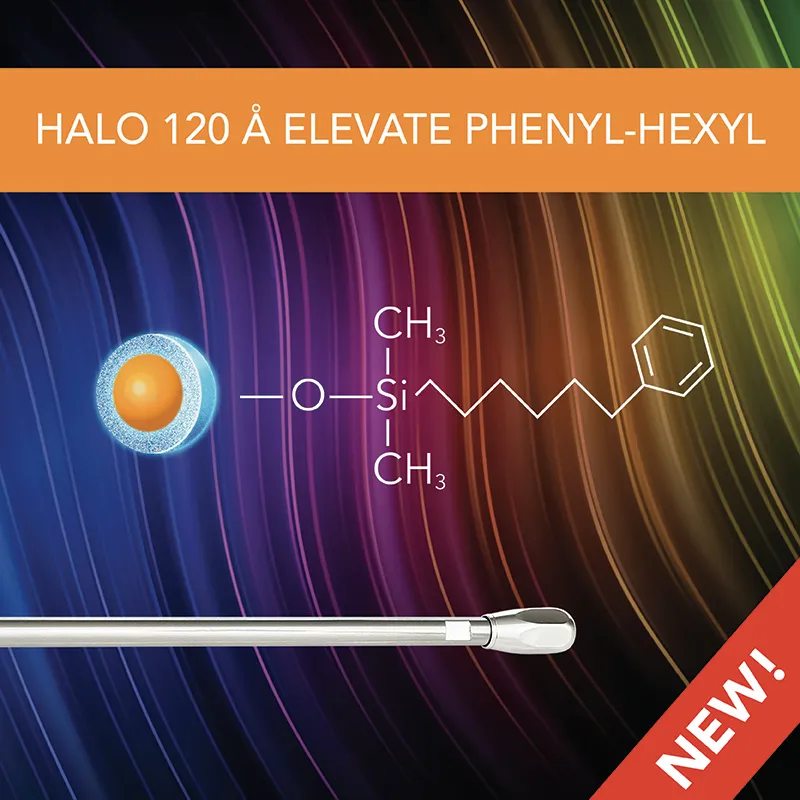
PHENYL-HEXYL
Ligand: dimethylphenylhexyl
Particle Size: 2, 2.7 and 5µm
Pore Size: 120 Å
USP Designation: L11
*Reported: 2, 2.7, 5µm respectively
Carbon Load: 4.5%, 5.1%, 4.0%
Surface Area*: 70, 75, 60 m2/g
Endcapped: YES
pH Operating Range: 2-12
Temp Limit: 60 °C
Pressure Stability*: 1000, 600, 600
HALO® Advantage!
HIGH pH STABILITY TESTING @ 50 °C
A combination of neutrals and bases are observed on a HALO® ELEVATE C18, C8, and Phenyl-Hexyl column showing excellent reproducibility over 9,000 column volumes. Separation is performed under high temperature (50 °C), and high pH (10), isocratic conditions.

The chromatograms that were included in the stability run above are to the right. Each product chemistry chromatogram, from beginning and end of the run, all demonstrate excellent stability of performance over time.


High Temperature / pH Amitriptyline Stability using HALO® Elevate


The HALO® ELEVATE column line incorporates a wide pH compatibility which allows not only chromatographic separations to be performed under low pH conditions, but high pH options are also available (pH 2-12). This versatility allows for easier method development along with achieving selectivity differences that may benefit separation. The figure below shows a mixture of an acid (not labeled) base, and neutral analyte run under low, medium, and high pH conditions.

ANTIDEPRESSANTS – HALO® ELEVATE C18 vs. FPP
A separation of antidepressants is achieved under high pH conditions using a HALO® ELEVATE C18 and Phenyl-Hexyl column against the FPP competitor columns. The separations using HALO® were completed in approximately half the time with improved resolution.
PEAK IDENTITIES
- Amoxapine
- Desipramine
- Nortriptyline
- Doxepin
- Imipramine
- Amitriptyline
- Trimipramine

*see brochure
HALO® ELEVATE C18 vs. Competitor SPP
A separation of antidepressants is achieved under high pH conditions using a HALO® ELEVATE C18 compared to a competitor high pH stable SPP column. Utilizing the same conditions, the HALO® column achieves comparable resolution in a faster run time.
*see brochure
PEAK IDENTITIES
- Amoxapine
- Desipramine
- Nortriptyline
- Doxepin
- Imipramine
- Amitriptyline
- Trimipramine
Advantage of HALO® ELEVATE Load Capability at High PH
At low pH, basic compounds are protonated, causing unwanted interactions with surface silanols. At high pH (ideally 2 units above the analyte’s pKa), they deprotonate, increasing retention, improving peak shape, and allowing for much higher sample loading. The figures demonstrate this using the basic drug trimipramine under low and high pH conditions across various sample loads.


Featured Documents
SHOP HALO® ELEVATE
-
 Select options This product has multiple variants. The options may be chosen on the product page
HALO 120 Å ELEVATE C18
Price range: $615.00 through $2,985.00
-
Select options This product has multiple variants. The options may be chosen on the product page
HALO 120 Å ELEVATE C8
Price range: $615.00 through $2,585.00
-
Select options This product has multiple variants. The options may be chosen on the product page
HALO 120 Å ELEVATE Phenyl-Hexyl
Price range: $615.00 through $2,585.00
taking advantage of fused-core® technology
Visit our solutions pages to learn more about the best uses and benefits of Fused-Core® Technology.

From an ultra-fast separation of a few compounds to a more complex natural product sample containing hundreds of analytes, HALO® columns offer an optimized solution for separation challenges.

Biopharmaceuticals are inherently more complex than small molecules. HALO® BioClass columns have been specifically designed to accomplish these bio-separation goals with a simplified and more effective solution.

Solutions for other persistent, high environmental-impact contamination agents such as pesticides, mycotoxins, herbicides, and more all based upon HALO’s 15 years of innovative and trusted technology.